Univ.-Prof. Achim Menges
Univ.-Prof. Dr.-Ing. Jan Knippers
Philipp Kragl
Lasath Siriwardena
Otto Lindstam
Samuel Leder
Type:
Design
Semester hours:
10
Teaching Language:
English
Semester:
WS 26/27
Organisation:
Computerbasiertes Entwerfen und Baufertigung
Content:
The studio focuses on design, development and fabrication of a research-driven architectural installation which is planned to be constructed between the K1 and K2 university buildings in the summer.
The project offers students the opportunity to participate in interdisciplinary and integrative design research that bridges computational design, planning, simulation and production methods. The studio includes all phases of project development: from research to digital planning and simulation to robotic manufacturing and on-site assembly (if paired with the summer semester studio).
Students will investigate computational design strategies and fabrication techniques for natural structures in order to identify potential future trajectories while positioning analyzed precedents within the larger disciplinary context. Based on these initial studies new material-based fabrication concepts and resulting morphospaces will be explored.
The outcome of these investigations will include an overview of the research topic within the wider disciplinary context, and a series of research-informed design proposals, and prototypical fabrication concepts.
The most promising concept developed during the winter semester will form the conceptual and technical basis for the ITECH Research Demonstrator to be realized in the following summer term.
Univ.-Prof. Achim Menges
Univ.-Prof. Dr.-Ing. Jan Knippers
Katja Rinderspacher
Univ.-Prof. Dr. Thomas Wortmann
Dr.-Ing. Tobias Schwinn
Type:
Design
Semester hours:
10
Teaching Language:
English
Semester:
WS 26/27
Organisation:
Computerbasiertes Entwerfen und Baufertigung
Content:
The second year of the program is designated for the development of the master’s thesis. The third semester aims at laying the foundation for a promising master’s thesis through a Thesis Preparation Project supported by an integrated Master Thesis Preparation Seminar and two supplementary seminar modules.
The thesis preparation project engages the students in the selection and development of a suitable master’s thesis research proposal within a wide range of topics within contemporary architectural design research. Each year a number of specialized topic areas are offered by the participating institutes. These research areas are directly supported by expert researchers and open up the possibility for students to directly engage, through their thesis, in state-of-the-art design research questions. Additionally, students are also encouraged and supported in the development of their own architectural design research interests. Areas of research focus can include: computational design and fabrication, morphological differentiation, material assembly, as well as material behavior-driven system performance. The aim is for each sub-topic to be investigated in the context of full-scale architectural prototyping. In this regard, each research subtopic can be explored as an individual aspect of a larger common project to be developed throughout the master’s thesis phase.
Students are responsible for conceptualizing, framing, and developing their own thesis topic under the supervision of their tutors and supervisors. Given the interdisciplinary and research-based nature of the program, each student must select a supervising professor from one of the institutes involved, suitable tutors, and any additional supporting resources that may be required.
Univ.-Prof. Achim Menges
Xiliu Yang
Hana Svatos-Raznjevic
Katja Rinderspacher
Type:
Colloquium
Semester hours:
2
Teaching Language:
English
Semester:
WS 26/27
Organisation:
Computerbasiertes Entwerfen und Baufertigung
Content:
The ITECH Master Thesis Preparation Seminar investigates the logical argument required to make a sound ‘intellectual proposition’ - a thesis. In other words, it is concerned in ‘how to’ conduct and structure research rather than ‘what’ specific subject matter you intend to research. The seminar introduces the core aspects required to undertake scientific research independent of the field or the contents of the work. These structures are widely accepted across multiple disciplines and not only form part of presenting academic and scientific research but are also fundamental to conducting the research itself. The basic parts or chapters of such a research document will be introduced in general and with regards to the research field of architecture. Emphasis is laid on developing a mode of thinking and researching rather than presenting, thus turning the research methods into an operative tool of design. The Master Thesis Preparation Seminar aims at aiding the ITECH master’s candidates to both build their thesis in a scientific manner and to identify further research resources that need to be incorporated into the proposal. It is thus not a content-specific seminar but rather methodological in nature. The seminar will address both the structural requirements to properly develop a successful Thesis proposal but it will do so under the larger framework of the overall thesis dissertation. For this purpose, the three Thesis Tracks of the ITECH program will be addressed individually, specifying how the overall Scientific Research Structure needs to be formulated to account for each track’s focus. The seminar is centered around a workshop with an introductory lecture on research structure and its modifications to suit a specific research track. A common workshop and individual tutorials will help to kick-start each student’s formulation of their research document. As the seminar functions in support to the ongoing academic research work of the thesis candidates, the content of the document is to be developed by the candidates over the course of the term with the support of the thesis tutors. An intermediate progress review with the thesis tutors will take place prior to final submission.
The Expert Colloquium introduces students to knowledge and information about the current state of integrative technologies in practice and research, presenting the work of experts ranging from design architects and engineers to manufacturers, scientists and researchers. It offers students the possibility to discuss their own work with experts in the field as a base for further development.
Nature has been an inspiration for architects and engineers for a long time, even before terms like bionics or biomimetics were formally introduced. Looking at how nature works provides a fascinating pool of information to draw from in an architectural context. Not ruled by constraints immanent to the building industry, natural structures are multi-layered, highly differenti-ated systems, finely tuned and assembled from basic components with mani-fold interrelated functions of nearly infinitely diverse articulation. Those formally rich articulations often stem from the quest for material effi-ciency - in nature material is expensive but diversely articulated shapes, catering to specific functional demands prevail, whereas in architecture and construction mostly the inverse is true.
While there have been a considerable number of attempts to transfer ideas derived from nature to architectural systems in the twentieth century, they were profoundly limited by structural calculability and the dominant con-straints of serial production.
With the recent advances in design computation, structural simulation and robotic fabrication, the boundary between the underlying logics of ‘natural’ and ‘man-made’ structures can be re-explored and redefined.
Particularly the notion of re-configurability, adaptability and reuse - being key mechanisms of natural organisms to cope with manifold changing condi-tions and challenges - call to be investigated from within the realm of archi-tecture.
The seminar will be structured in the following phases: A1: Introduction lectures A2: Initial screenings and role model selection A3: Identification and abstraction of functional principles B: Transfer and technical development
Phase A2, A3 and B will be in smaller groups of 3-4 Students, in collaboration with biology students from the University of Tübingen. Meetings with these smaller groups will be held partly on Webex.
Computational Design Techniques and Design Thinking
Number:
311621700
Lecturers:
Univ.-Prof. Achim Menges
Juan David Frank Spinel
Harrison Hildebrandt
Dr.-Ing. Tobias Schwinn
Type:
Seminar
Semester hours:
4
Teaching Language:
English
Semester:
WS 26/27
Organisation:
Computerbasiertes Entwerfen und Baufertigung
Content:
Computation has a profound impact not only on industry and society, but also on our contemporary understanding of architectural form, space and structure. Computation has shifted the way in which architecture is conceived, produced, adopted and, ultimately, repurposed. Digital computation is enabled by the implementation of algorithms on a computer, which happens through programming languages. This is a fundamental property of computation as a technical achievement, but also as a theoretical framework for design.
This seminar will lay the foundations for harnessing the potential of computation for architectural design and production. The course consists of three main parts:
- Introduction to Python, - Introduction to Robotics, - Algorithmic Design.
In the first lectures, Visual Studio Code will be used as the code editor to learn Python. From week 5 onwards, Rhinoceros 8 1) CAD software and its Grasshopper plug-in will be introduced. Throughout the seminar, participants will have access to a shared GitHub repository containing all developed Python scripts and Grasshopper definitions.
By participating in this seminar, students will gain hands-on programming experience with Python, learn to use Git for version control and collaboration, and explore algorithmic form generation through the RhinoCommon API within Rhino and Grasshopper. They will be introduced to robot programming using KUKA robots and examine computational principles behind patterns in the physical world.
First session: Oct 15, 2026, 9:45 AM in room 9.06, K1
Univ.-Prof. Dr. Thomas Wortmann
Ilyas Abdelmoula
Alfiia Shakurianova
Type:
Seminar
Semester hours:
4
Teaching Language:
English
Semester:
WS 26/27
Organisation:
Computerbasiertes Entwerfen und Baufertigung
Content:
Deep generative models and reinforcement learning transform the architectural design landscape by creating diverse design options that respond to real-world constraints. This course invites students to explore how these advanced AI techniques can be harnessed in architectural design to generate creative possibilities and improve design outcomes.
Students will gain hands-on experience training, deploying generative models that create novel architectural forms and design elements, and designing reinforcement learning frameworks that iterate on architectural solutions.
Beyond technical skills, students will discuss the implications of generative AI for the future of architecture, exploring its potential and ethical considerations. Critical reflection on the limitations of these methods will be an integral part of the course, as students will examine issues such as the potential for bias in AI-generated designs, the challenges of ensuring design feasibility, and the ethical implications of replacing human creativity with automated processes.
The module includes lectures, tutorials, and projects where students apply their knowledge to design challenges. Assessment is based on weekly assignments and a final group project showcasing the application of generative models and/or reinforcement learning to a design problem.
The seminar prepares students for the appropriate, efficient, and low-emission use of construction materials in structures. It covers a broad range of materials, including timber, steel, concrete, composites, and bio or geo based materials such as natural stone and clay, building an engineering understanding of their properties, load-bearing behaviour, and performance so that they can be selected and used according to their strengths. The engineering fundamentals of dimensioning are developed in depth on the principal structural materials timber, steel, and concrete, while innovative and biogenic materials are addressed as an emerging field. Each material is examined along a consistent scheme: the material itself, the structures that arise from it, and its manufacturing and life cycle impact. The Life Cycle Assessment (LCA) method is introduced to quantify embodied carbon (GWP) and whole life carbon, and principles of lightweight construction are studied to achieve high structural performance with minimal material use and low emissions. Through practical exercises, students develop structural solutions that combine low resource consumption with high load-bearing capacity. The seminar thereby establishes the basic material knowledge that underpins the design work in Form and Structure.
Univ.-Prof. Achim Menges
Dr.-Ing. Tobias Schwinn
Fabian Kannenberg
Samuel Slezak
Ekin Sila Sahin
Xiliu Yang
Lasath Siriwardena
Type:
Seminar
Semester hours:
4
Teaching Language:
English
Semester:
WS 26/27
Organisation:
Computerbasiertes Entwerfen und Baufertigung
Content:
Traditional notions of digital design and fabrication are based on the exact execution of a priori defined symbolic plans, such as detailed digital design models. Those plans and models, however, never match physical reality.
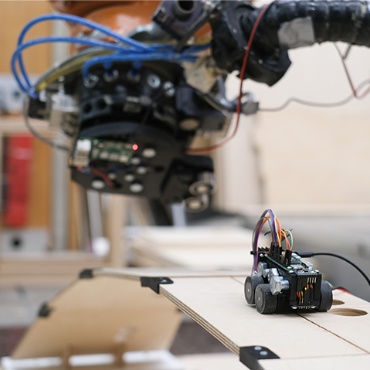
The alternative, which we call behavioral fabrication, is based on the concept of execution of behaviors. Such behaviors, which can be heuristic or learned, static or adaptive, represent design intention and unfold in a non-deterministic way based on the constant interaction of the machine/robot/agent with the material and its environment through sensor-actuator feedback.
Students can expect to learn the required computational techniques for behavioral fabrication: behavioral robotics, advanced methods of communication for seamlessly integrating sensing, tracking, and acting, and Human-robot collaboration.
First session: Oct 13, 2026, 9:45 AM in room 9.06, K1